
BNSF Lift Bridge, Prescott

Engineering Marvel

Click to zoom photo

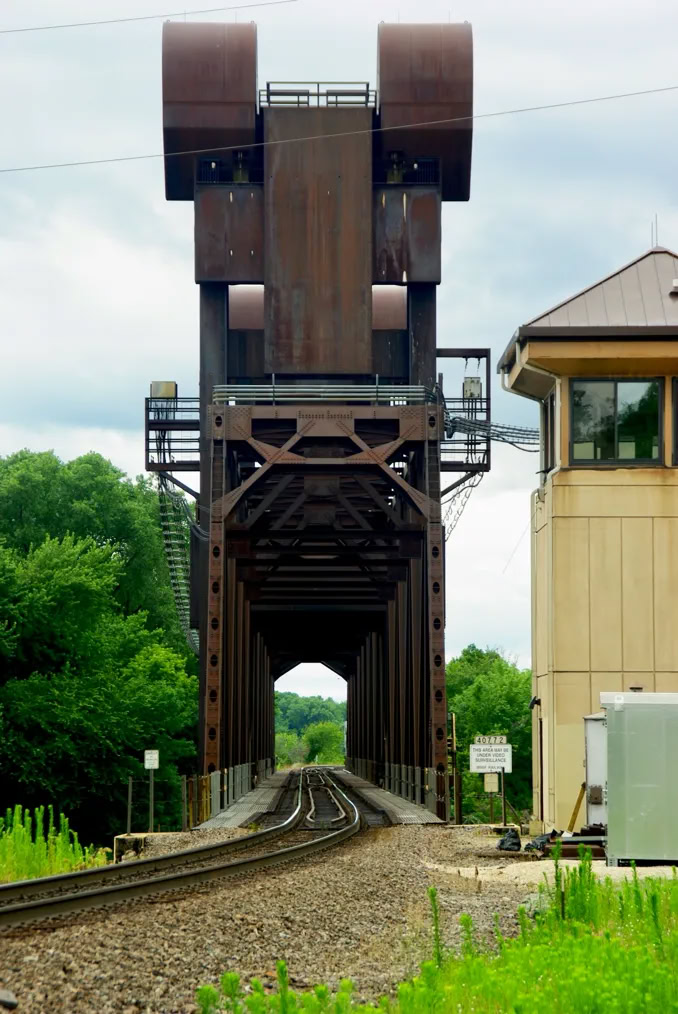
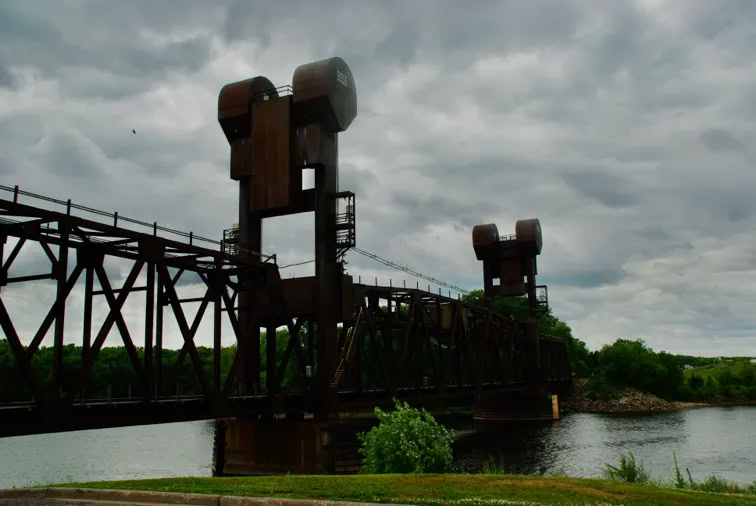
The Burlington Northern & Santa Fe (BNSF) list bridge crossing the St. Croix River just as it meets the Mississippi River is quite a sight and engineering feat. It connects to Point Douglas Park in Hastings, Minnesota, from Prescott, Wisconsin.


It is a vertical lift bridge carrying BNSF railway tracks. It replaced a swing bridge at the same site. The center section lifts up so boat traffic below can pass.


It is a wonderful structural sight when standing still. It is even more wonderful if you can catch it being raised as a train can pass across.

The Library of Congress tells us,


“(It) is a rare regional example of a Waddell-and-Harrington, vertical-lift highway bridge. Built by a group of Prescott residents who operated it as a toll crossing from 1923 to 1946, the bridge proved to be a successful commercial venture. 


“The Minnesota and Wisconsin Highway Commissions in 1946 purchased the bridge and removed the toll to facilitate travel and commerce. By 1969, the Prescott Bridge could not accommodate current traffic needs, and it was scheduled for replacement.”

It was rebuilt in 1984.


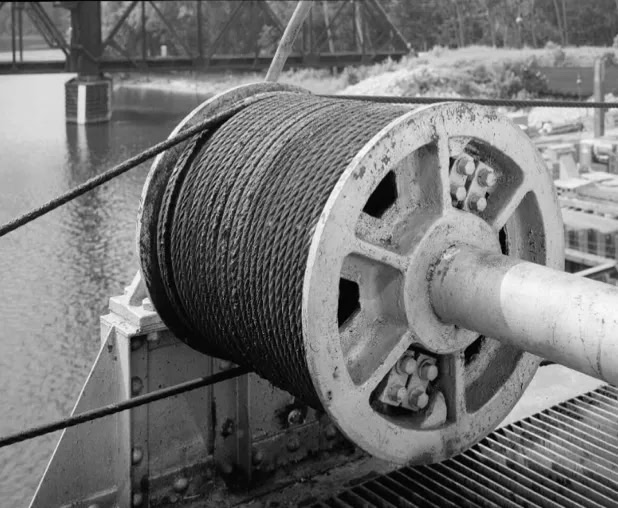
The two circular objects atop the bridge house circular winding drums of cable that lift and lower the bridge vertically.


William E. Nyman and Hardesty & Hanover published a paper in 2002, “Dr. J.A. Waddell’s contributions to vertical lift bridge design which says,


“Dr. John Alexander Low Waddell is generally considered the father of the modern vertical lift bridge, one of the three primary movable bridge types that are common throughout the United States today.


“Prior to 1890, practically all major movable bridges were the swing span type. Swing spans were cost-effective, functioned well where unlimited vertical clearance was required for tall-masted vessels and the center pivot pier did not pose an objectionable hazard to navigation.


“Waddell lists the advantages of vertical lift bridges as compared to rotating drawbridges:


“A lift bridge gives one wide channel for vessels instead of the two narrow ones afforded by a center-pivoted swing bridge.


“There are no land damages in the case of a lift-bridge, as the whole structure is confined to the width of the street. These land damages in the case of some swing-bridges amount to a large percentage of the total cost of structure.


“Vessels can lie at the docks close to a lift-bridge, which they cannot do in the case of a swing-bridge; consequently with the former the dock-front can be made available for a much greater length between streets than it can with the latter.


“The time of operation for a lift-bridge is about 30% less than that for a corresponding swing bridge.


“Waddell goes on to list the advantages of a lift-bridge in comparison to a bascule or jack-knife draw, both of these being supposed to be without a center pier, as follows:


“The lift-bridge can be made of any desired span, while in the case of the others the span is necessarily quite limited in length.


“A lift-bridge can he paved while the others cannot.


“The lift-bridge is very much more rigid than any structure composed of two or more partially or wholly independent parts, a feature characteristic of the jack-knife bridge or the bascule without a center pier.


“In a lift-bridge the operating machinery is much more simple; and, in case that it should ever get out of order, the span can be raised or lowered either by unbalancing, or by simple hand mechanism, or by both combined.”


John Lyle Harrington, known as “Mechanical Master of the Vertical Lift Bridge,” partnered with Dr. Waddell, and interned while in college under Waddell. Dr. Waddell designed the first vertical lift span built in Chicago. The firm Waddell and Harrington designed about 24 vertical lift bridges.

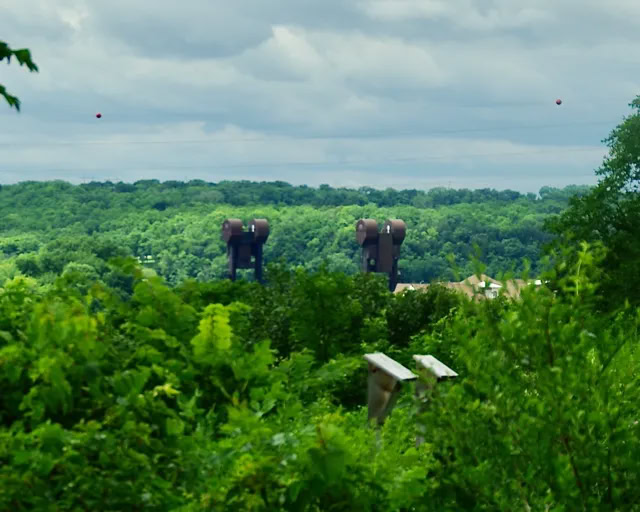
I must say that my first view of this bridge was from the


Great River Road Interpretive Center at Freedom Park , positioned on a bluff 400 ft. above the river, just a tad to the southeast of Prescott on Hwy 35.


My first thought was, “Wow, two Mickey houses!” Then, “What in the world is that?” I asked and then visited the bridge. What a terrific surprise.