

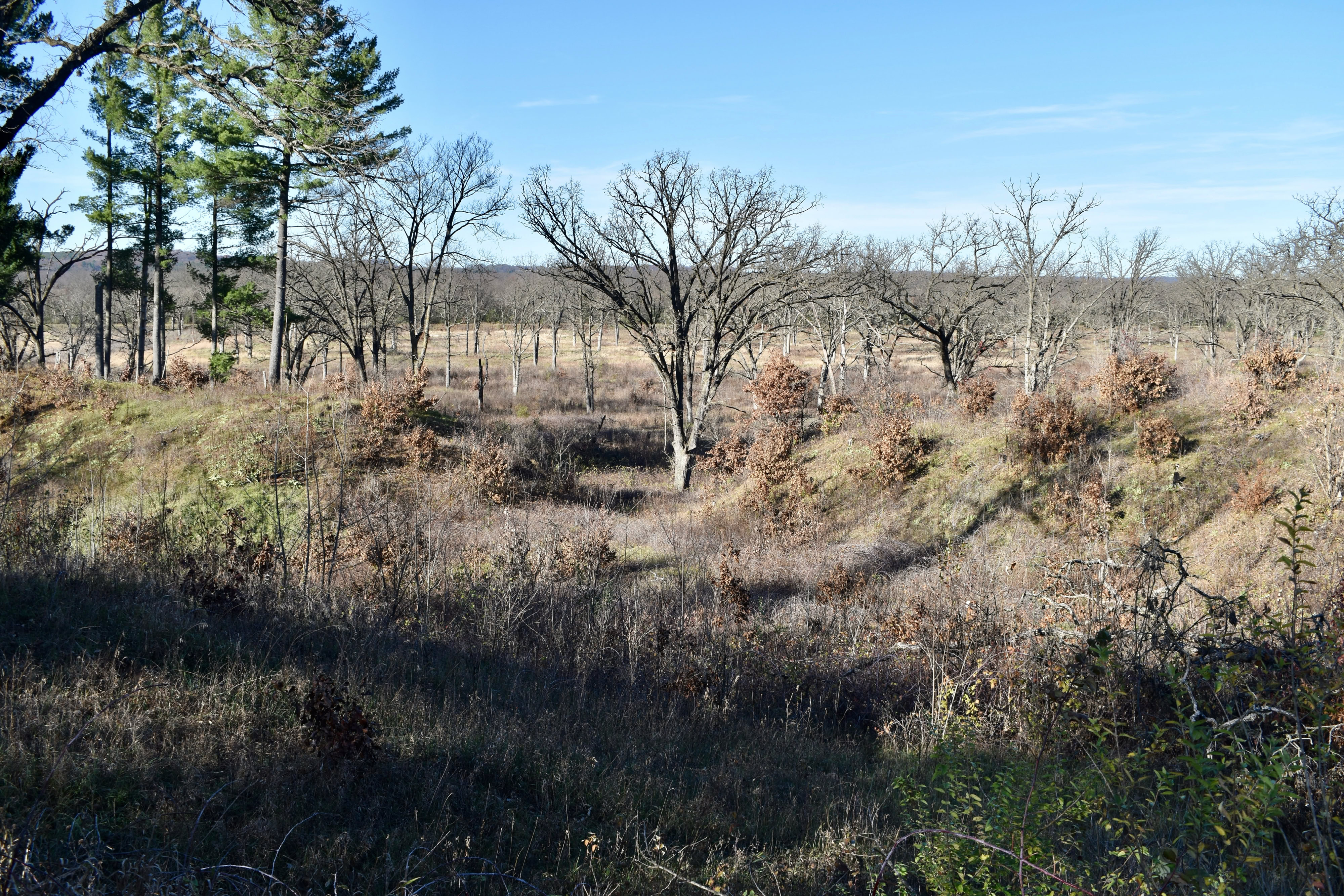
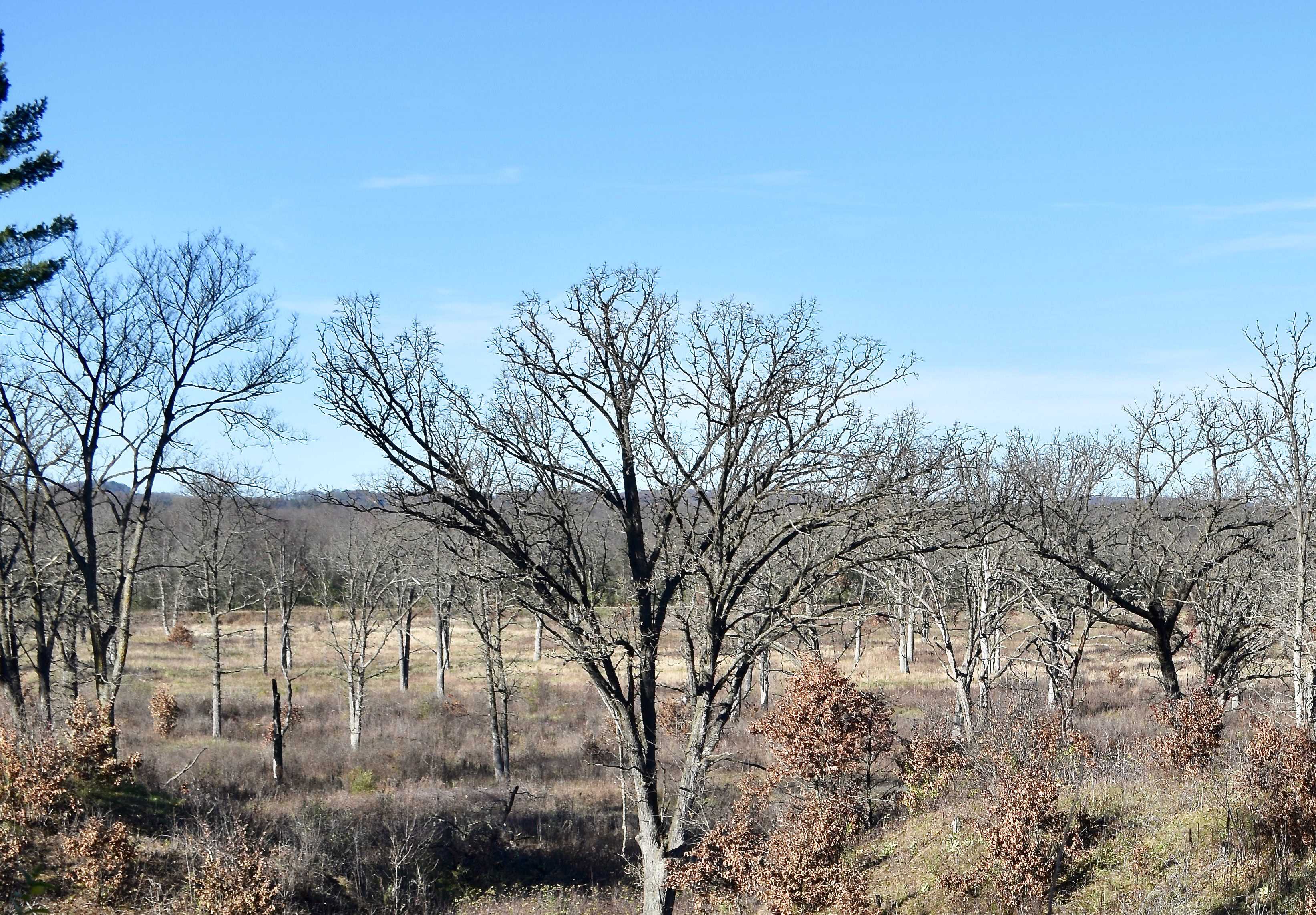
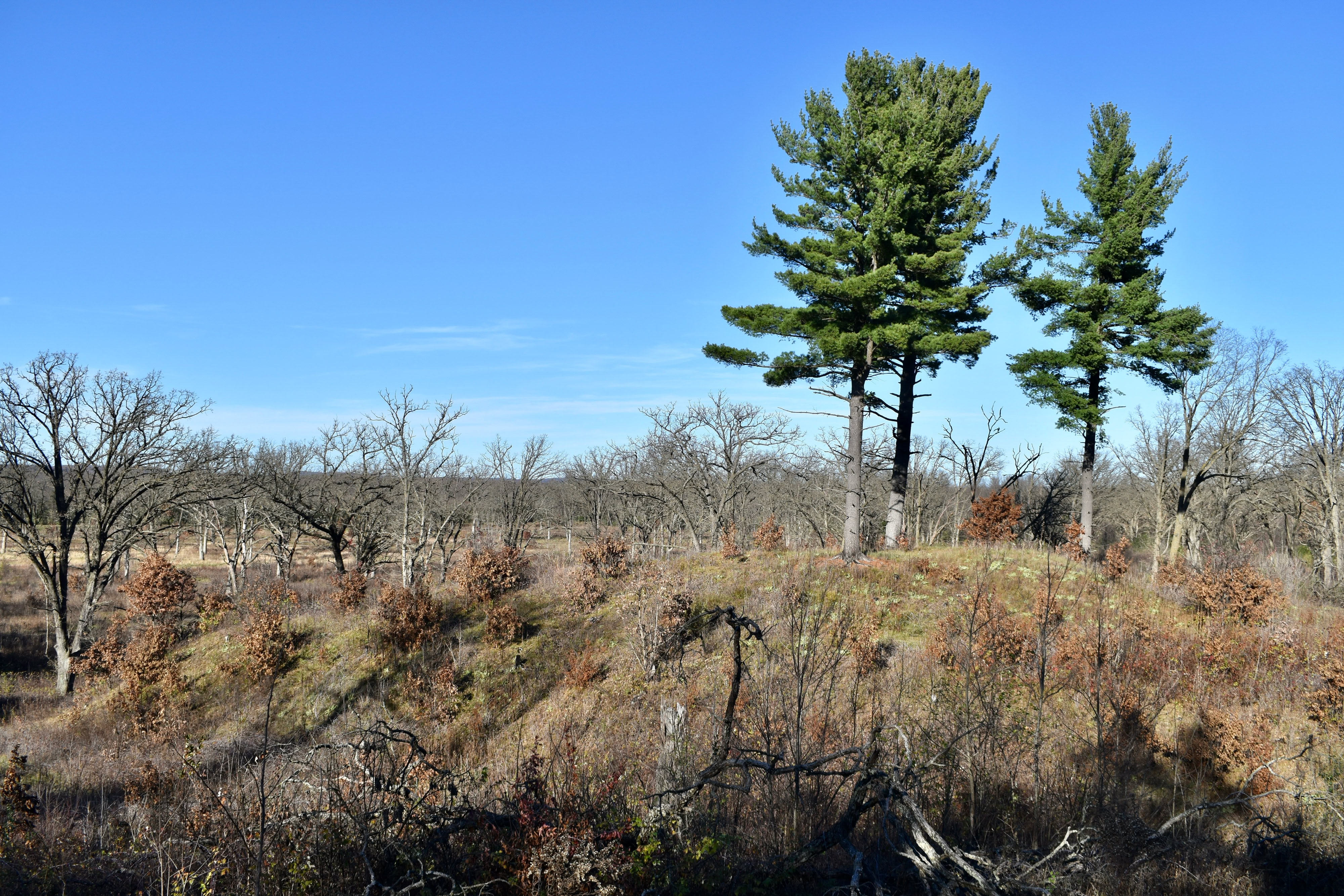
I was driving on a back road (CR M and 50th Ave) along the Lower Chippewa River between Eau Claire and Durand when I noticed a curious scene: small ridges and a flat, barren area dotted with tall trees. It was beautiful in its own way, but I had no idea what I was seeing. I later took a friend to the same location, and she knew exactly what it was: eskers and an oak savanna.
The Wisconsin Department of Natural Resources describes this geologic environment. It refers to the oak savanna's “oak openings” and says,
“The best remaining sites are found in the Driftless Region on steep west- to south-facing slopes where they are associated with dry prairies on bluffs …
“They occur on gravelly kames, eskers, and along end moraines, especially in the southern Kettle Moraine region … (They are also) associated with large river systems, such as the Wisconsin, Black, and Chippewa Rivers, where they are sometimes also referred to as floodplain savannas.”
Wisconsin’s Driftless Region is the area not covered by glaciers.
Recognize that these processes occur as the glacier withdraws; its melting produced enormous volumes of water, more than most of us can fathom. This meltwater carried vast amounts of sediment, carved valleys and gorges, and diverted pre-glacial rivers. Furthermore, areas not covered by the glacier sat adjacent to it, producing intense freeze-thaw cycles that accelerated erosion.
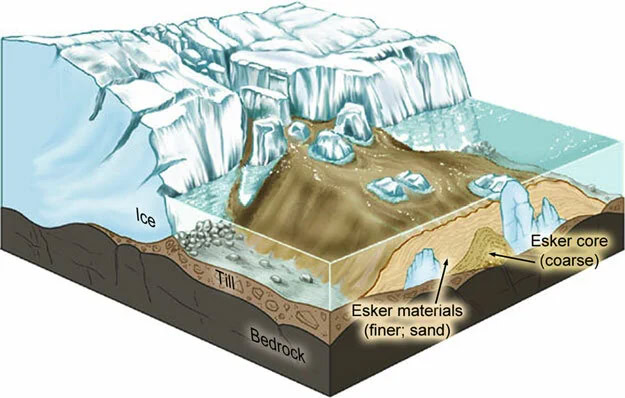
Water from the melting glacier can flow on, within, below, or in front of the glacier. Some of it can even drain through the glacier's crevasses.
The science behind this evolution is fascinating, and one can likely build a career studying it.
An esker is “a fluvioglacial deposit formed inside a glacier.” It is also called “glaciofluvial.” Both terms describe the process in which a glacier melts, its meltwater flows, and the resulting erosion and sediment-rich deposits increase the meltwater’s erosive power.
Kames are steep-sided, irregularly shaped hills, knobs, or short ridges composed of stratified sand, gravel, and till. A moraine is any accumulation of unconsolidated rock debris, soil, and sediment (known as glacial till) deposited by a moving or melting glacier or ice sheet.
Savannas are a mixed woodland-grassland ecosystem. The trees are widely spaced, allowing sunlight to reach the ground and sustain a thick, continuous layer of grass.
These oak savannas have become rare plant communities. Many of them have been converted to agriculture, settlements, or grazing. Once that happened, fires occurred. The net result is that few of these sites remain.
Interestingly, Oak trees can survive such fires, and the underlying brush can rejuvenate. Their thick bark insulates them; they can resprout from underground root systems; and fast-growing cells isolate wounded areas, preventing infection.
The Wellness Esker in St. Croix Falls is Wisconsin's highest esker, standing about 130 feet tall. It is part of the Ice Age Trail system. From the top, you will see the St. Croix River Valley below, extending into Minnesota. The esker is near residences and a hospital.
My friend and I spotted an esker in the Lower Chippewa River State Natural Area. It features the largest concentration of remaining prairies and savannas in the state. It hosts the largest contiguous floodplain forest in the Midwest.
I wish my camera captured photos in three dimensions. My photos don’t do justice to the eskers’ curves and rises, the dimensions of the oak opening, or the savanna beyond. Use your imagination. Better yet, go out to see it for yourself, either up to St. Croix Falls or to the Lower Chippewa Valley State Natural Area.